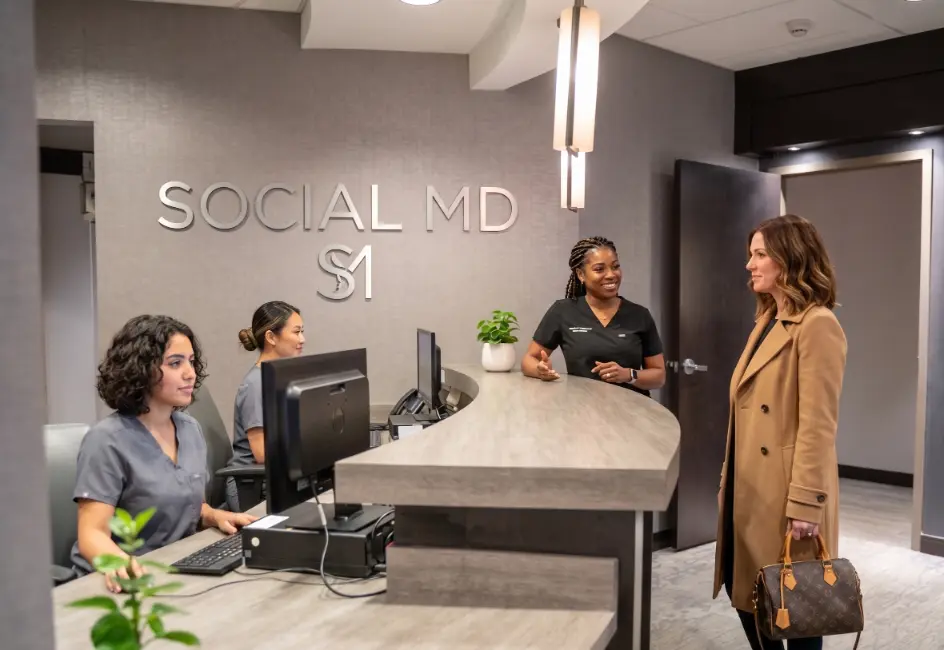
You've invested in top-tier injectors, premium equipment, and a beautiful space. Your marketing is driving inquiries. But somewhere between the first phone call and the booked appointment, patients are slipping away — and the front desk is usually where it happens.
This isn't a criticism of front desk staff. Most of the time, the problem isn't the people — it's the systems, the training, and the standards that haven't been put in place. The front desk team can only perform at the level they've been set up to perform at.
As a medspa owner or practice manager, this is your highest-leverage area. Fixing these gaps doesn't require more marketing spend. It requires looking honestly at what's happening between your front door and your treatment rooms.
What the Numbers Tell Us
Before we get into specifics, consider the scale of what's at stake. A practice seeing 20 new inquiries per week that converts at 40% is booking 8 new patients. Improving that conversion rate to 60% — without spending a single dollar more on marketing — adds 4 additional patients every week. That's over 200 additional patients per year from the same marketing budget.
"The front desk isn't just an administrative function. It's your first impression, your conversion engine, and your retention system — all in one role."
The 7 Most Common Front Desk Missed Opportunities
Answering the Phone Like It's an Interruption
Every inbound call is a patient who decided to reach out — often after researching multiple practices. If the call is answered with a flat tone, rushed energy, or put immediately on hold, that patient's first impression is already working against you. Many will hang up and call someone else.
The FixTrain your team to answer every call as if it's the most important call of the day — because it might be. Create a standard greeting, set a two-ring answer policy, and role-play call scenarios monthly so the team stays sharp.
Slow Response to Online Inquiries
Web forms, Instagram DMs, and contact page submissions are high-intent leads. Patients submitting these are actively ready to book. When a response comes back 6 hours later — or the next morning — that patient has often already booked elsewhere.
The FixSet a 5-minute response standard for all online inquiries during business hours. Use automated acknowledgment messages that set expectations and keep the lead warm. Assign a specific team member to own this channel daily — don't leave it to whoever gets around to it.
Quoting Prices Without Building Value First
When a patient asks "how much does Botox cost?" and the front desk answers "$14 a unit" — that's the end of the conversation for a price-sensitive patient. They hang up, compare that number to the cheapest option they can find, and book there instead.
The FixTrain your team to build value before quoting price. Ask what the patient is hoping to achieve, explain what a consultation looks like, and communicate what makes your practice different. Price means something different when it's attached to expertise and trust.
No Follow-Up on Unbooked Inquiries
A patient calls, asks questions, says they'll "think about it" — and that's where it ends. No follow-up call. No email. No text. That patient had enough interest to pick up the phone, and they were left to go cold on their own.
The FixBuild a simple follow-up sequence: a same-day or next-day personal call, followed by a text or email if no response. Keep it warm and non-pushy. Something as simple as "We had a great conversation — wanted to check if you had any other questions" converts a meaningful percentage of these leads.
No-Show Recovery That Goes No Further Than a Missed Appointment Note
A patient no-shows. The slot gets marked and moved on from. No call. No rebook attempt. That patient — who was already far enough along in the buying journey to have booked — is now lost, often permanently, because no one reached back out.
The FixCreate a same-day no-show protocol: a call within 30 minutes of the missed appointment, followed by a text. Make it easy for them to rebook — offer a specific opening rather than asking them to check the schedule themselves. Most no-shows are logistical, not a change of heart.
Missing the Upsell Conversation at Check-In and Check-Out
A patient arrives for their Botox appointment and checks in. No one mentions the membership. No one mentions the skincare promotion. No one mentions that the provider also does PRF and they're a great candidate. That patient leaves having spent only what they came to spend — which is the minimum.
The FixGive your front desk team a simple daily brief on what to mention — current promotions, membership benefits, add-on services relevant to that patient's treatment. Make it conversational, not pushy. "A lot of our Botox patients have been pairing it with our new collagen serum — it extends the results. Want me to grab some info?" is easy and effective.
Not Asking for Reviews at the Right Moment
The best time to ask for a review is when a patient is at peak satisfaction — right after a great result, during checkout when they're glowing about their treatment. Instead, most practices send a generic automated email three days later, which patients ignore.
The FixTrain your front desk to ask personally at checkout when a patient expresses satisfaction. "We're so glad you love it — would you mind leaving us a quick Google review? It means the world to us." A warm, in-person ask converts at a dramatically higher rate than any automated message.
Want to Know Where Your Practice Is Leaking Revenue?
We do a free growth audit for aesthetic practices — mapping exactly where patients are slipping through and how to fix it.
Claim Your Free AuditThe Front Desk Is a Revenue Position — Treat It Like One
Most medspa owners think about their front desk as an administrative cost. The best operators think about it as a revenue position — because that's what it is. Every interaction has a dollar value attached to it, and the gap between a well-trained front desk and an untrained one is often six figures annually.
That means:
- Front desk staff need ongoing training — not just onboarding and then nothing
- Performance should be measured — conversion rates, follow-up rates, review requests
- Scripts and standards should exist — so great performance isn't dependent on personality alone
- The role should be compensated in a way that reflects its impact — consider performance incentives tied to bookings and reviews
When your front desk operates like a high-performing sales and service team, everything else in your practice gets more efficient. Marketing spend goes further. Patient retention improves. Revenue per visit increases. The investment in training and systems pays for itself many times over.
Your Front Desk Audit Checklist
Use this to evaluate where your practice stands right now. If you're checking fewer than 8 of these boxes, you have meaningful revenue sitting on the table.
Inquiry Handling
- Phones answered within 2 rings
- Standard warm greeting in place
- Online inquiries responded to within 5 min
- Auto-acknowledgment for after-hours leads
- Value communicated before price is quoted
- Unbooked inquiries followed up same day
Retention & Revenue
- No-show same-day call protocol exists
- Cancellations offered immediate rebook
- Promotions communicated at check-in
- Membership mentioned to eligible patients
- Review request made in person at checkout
- Rebooking offered before patient leaves
The Practice That Wins Is the One That Closes the Gaps
Aesthetic medicine is a competitive market. The practices growing fastest aren't always the ones with the best injectors or the biggest marketing budgets. They're the ones that have built systems around every patient touchpoint — including, and especially, the front desk.
The good news: every one of these missed opportunities is fixable. None of them require new technology, new hires, or new spend. They require attention, standards, and consistent execution.
Start with one. Measure it. Then fix the next one. Within 90 days, the difference will show up in your numbers.